

A skin booster is a microinjection of stabilized hyaluronic acid spread evenly across an area of skin to hydrate it from within. It is not a filler, and it is not Botox. It does not change the shape of the face. What it does is improve how skin holds water and reflects light, which is why patients describe the result as a glow rather than a change in their features. Injectable hydration treatments have expanded quickly. There are now several brand families on the Canadian market, each with slightly different formulations and protocols. The differences matter, but the underlying principle is the same.
What Is It?
The active ingredient in nearly every skin booster on the market today is stabilised hyaluronic acid. Hyaluronic acid (HA) is a sugar molecule the body produces naturally, found in connective tissue, joints, and especially in the skin’s middle layer. A single HA molecule can hold up to a thousand times its weight in water. As we age, the natural HA in skin breaks down faster than the body can replace it. By the late 20s, the slow decline has begun. By the late 30s, it’s visible.
The injectable solution restores some of that lost reservoir directly. The placement matters. A skin booster goes into the deeper layers of the dermis, evenly distributed in small amounts across an area, rather than concentrated in one spot to add structural volume. The result is a uniform improvement in hydration, glow, and surface smoothness.
Did you know
The hyaluronic acid in skin boosters is identical in chemistry to the HA your body produces. The difference is the cross-linking process, which slows how quickly the molecule breaks down and lets results last for months rather than days.
How Skin Boosters Work in The Skin
There are two-layered effects. The first is mechanical and immediate: the injected HA holds water in the dermis, plumping fine lines that come from dehydration and giving the skin a smoother, more reflective surface. That effect appears within days and continues to develop over the first two to three weeks.
The second effect is biological and slower. The presence of hyaluronic acid in the dermis stimulates fibroblasts, the cells responsible for producing collagen and elastin. Over the course of a treatment series, the skin’s own collagen production picks up modestly. Studies of skin biopsies before and after Profhilo, one of the most studied formulations, have shown measurable changes in dermal collagen and elastin density.
Who Skin Boosters Are Right For
Four patient profiles tend to do well with this category.
- Patients with chronically dehydrated, dull-looking skin. Especially noticeable across the cheeks, the area in front of the ears, and around the mouth. The improvement in light reflection alone is often enough to make the face look refreshed.
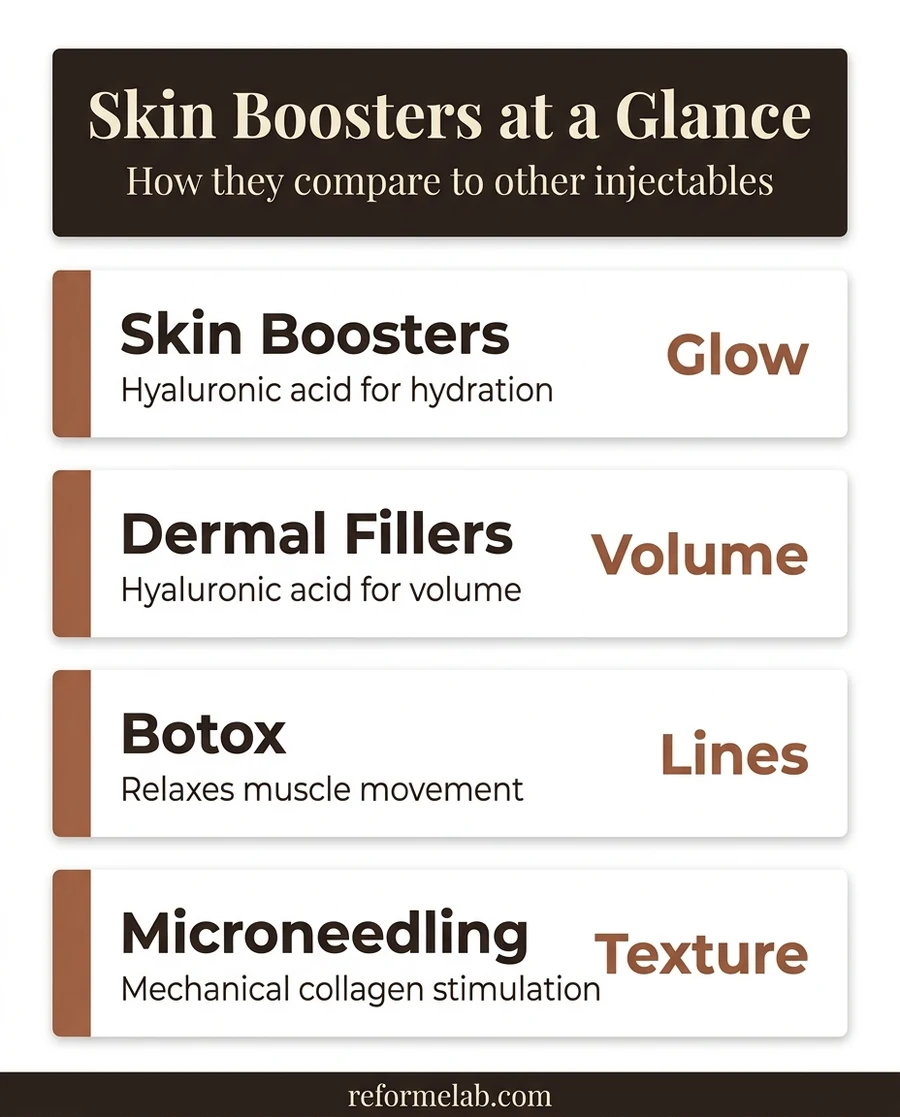
- Patients with fine lines from dehydration rather than muscle movement. Lines that show up at rest, particularly under makeup, are usually a hydration issue. Filler treatments address volume, Botox addresses movement, but skin boosters address surface quality.
- Patients with crepey skin on the neck, decolletage, or hands. These zones lose their natural HA stores faster than facial skin and are some of the first places to show age. Skin boosters in these areas tend to make the most visible difference.
- Patients building a long-term plan rather than chasing a single result. Skin boosters are at their best as part of a sustained skincare strategy, not a one-time event.
Pro tip
A common mistake is treating skin boosters and topical hydration as alternatives. They aren’t. Patients who get the strongest results pair injectable hydration with a serious daily routine that includes a humectant serum (think hyaluronic acid or polyglutamic acid) layered under moisturiser. The injectable handles the deep dermis. Your daily routine handles the surface. Together they outperform either alone.
Who Should Skip Them
Skin boosters are not the right tool for several common concerns. Patients who are looking for facial volume, lifting, or restoration of cheek projection are looking for dermal filler, not a skin booster. The two are sometimes lumped together in marketing material, but the molecules are formulated differently and the placement is different. Patients who want to soften crow’s feet, frown lines, or forehead lines are looking for a neuromodulator (Botox, Dysport, or similar), since those lines are caused by muscle movement rather than dehydration.
Patients with active inflammatory skin conditions (untreated rosacea, acute eczema, an active acne flare, perioral dermatitis) should wait until the skin is settled before starting skin boosters. The injection itself is well tolerated, but injecting into inflamed tissue increases the chance of bruising and may aggravate the underlying condition. A short course of skin-calming treatment first, then boosters, produces better outcomes.
How They Combine
Skin boosters are designed to work alongside other treatments, not instead of them. The most common pairings are with microneedling, with dermal filler, and with a Botox protocol. Each combination addresses a different concern.
With microneedling
This combination is particularly effective for patients with concerns about texture, mild acne scarring, or general skin dullness. Microneedling treatments create controlled microinjuries that stimulate collagen, while the skin booster delivers the hydration that supports the healing. Most clinics space the two by at least two weeks to let one settle before introducing the other.
With dermal filler
For patients getting filler in the cheeks, jawline, or chin, adding skin boosters makes the result look more natural. Filler restores volume, but if the overlying skin is dry and dull, the volume can read as artificial. Boosters improve the skin’s quality so the volume change reads as healthy fullness rather than puffy correction. Filler first, boosters two to four weeks later, is a typical sequence.
With Botox
Patients on a regular Botox schedule sometimes notice that their forehead, while smooth, looks paper-thin and reflects light differently than it used to. Adding skin boosters to that area restores some of the dermal substance and softens that effect. The two treatments don’t interact pharmacologically, and there’s no reason to space them more than a few weeks apart.

What We Use at The Lab
At Reforme Lab, we don’t believe in a one-size-fits-all approach to injectable hydration. Our medical injectors work exclusively with Profhilo® and Restylane® Skinboosters™ because these specific formulations deliver the most predictable, natural-looking results.
If your skin requires the widespread bio-remodelling benefits of Profhilo or the targeted, long-lasting micro-reservoirs of Restylane, our team uses these trusted international formulations to safely restore your skin’s internal hydration balance. Albeit these are European brands, they are fully Health Canada approved and represent the global gold standard in clinical safety and performance.
Common Skin Booster Brand Families
| Brand | What sets it apart | Typical protocol |
|---|---|---|
| Profhilo | Hybrid stabilised HA, spreads widely from a small number of injection points | Two sessions, one month apart, then maintenance every six to nine months |
| Restylane Skinboosters Vital | Stabilised HA in a slow-degrading gel, fine network across the dermis | Three sessions, one month apart, then maintenance every six to nine months |
| Juvederm Volite | Single-session formulation with results that last six to nine months | One session, then maintenance every six to nine months |
| NCTF (Filorga) | HA blended with vitamins, minerals, amino acids, and antioxidants | Three to four sessions over two to three months, then quarterly maintenance |
Brand availability and pricing vary by clinic and by region. Confirm directly with your provider what’s offered and what the recommended protocol is for your specific concerns.
Save your money
If your concern is dryness alone, start with a serious topical routine for three months before paying for injectable boosters. A well-formulated humectant serum, an occlusive moisturiser, and consistent SPF can produce a meaningful improvement on their own. If, after three months of consistent topical care, your skin is still not where you want it, that’s the right time to consider injectable hydration. Going straight to boosters when topical care hasn’t been tried is often money spent on a more expensive version of what cheaper products would have delivered.
A note on safety
Results vary. This article is for general information only and is not a substitute for personalized professional advice. Consult a licensed practitioner before starting any new treatment or routine. Reforme Lab is not responsible for outcomes from actions taken based on this content. Any cosmetic procedure carries some risk and requires a consultation to determine if it’s appropriate for you.
Download the free quick reference
Save the skin boosters quick reference as a PDF and bring it to your next consultation.
A Quick Reference to Skin Boosters (PDF)Sources and References
- Health Canada – Drugs and health products oversight
- Canadian Dermatology Association – Patient resources on injectable treatments
- Canadian Society of Plastic Surgeons – Patient information resources
- U.S. Food and Drug Administration – Dermal fillers and injectable products
Reforme Lab provides non-surgical aesthetic services across Mississauga and Toronto. Our team focuses on skin quality and natural-looking results. If you’d like to talk through whether injectable hydration treatments are a fit for your skin, book a complimentary consultation and we’ll walk through your options.
FAQs
Quick recap
- Skin boosters hydrate and improve skin quality, not volume.
- They work best for dehydration, fine surface lines, and crepey skin.
- They pair well with microneedling, dermal filler, and Botox.
- A consistent topical routine is a prerequisite, not an alternative.