
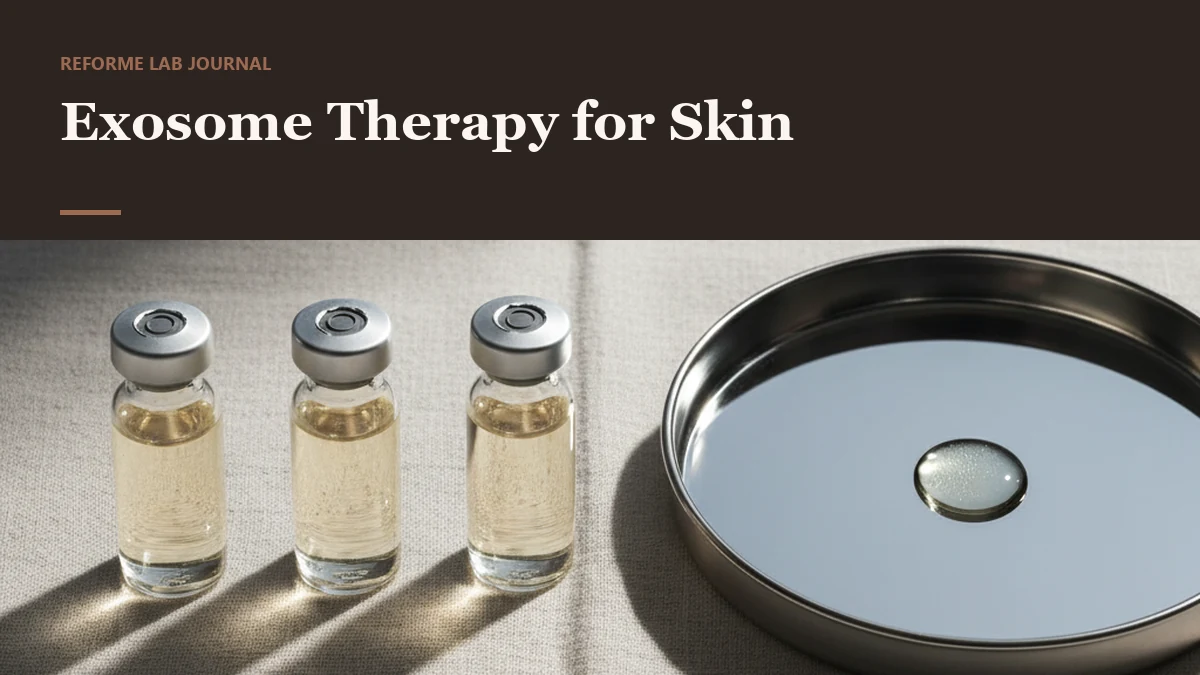
Health Canada has not approved any injectable exosome product for skin since topical use after microneedling is the standard in licensed clinics. That single line shapes the entire conversation about exosomes for skin in Toronto. It is also why we always start with microneedling and skin booster session when a patient asks where to begin.
Exosomes are nano-sized cell-signalling vesicles applied topically after microneedling or fractional laser to amplify the skin’s repair response. The rest of this guide is built around what the data and the chair time say, not what the marketing claims.
In This Guide
Are Exosomes Injected or Applied Topically?
In Canadian licensed clinics, exosomes are applied topically after microneedling or laser. Injection of exosomes is not authorized by Health Canada.
The most common mistake with exosomes for skin is sequencing. Done at the wrong moment in your routine, the same treatment gives you redness and rebound. Done correctly, the same treatment gives you visible change in 6 to 12 weeks. The chemistry is the same; the timing is not.
In a Toronto medspa context, exosomes for skin sits in a particular spot: not a quick fix, not a surgical commitment. Patients usually arrive after at least one product or trend hasn’t moved the dial. The conversation tends to start the same way – what is realistic, what is overhyped, and what does the calendar actually look like.
Toronto and Mississauga skin sees more seasonal swing than most cities. Winter dryness, summer humidity, and patio season UV exposure all change what exosomes for skin can deliver in any given month.
Patients often underestimate the home routine that supports exosomes for skin. A treatment chair gives you the result – a calm, well-built morning and evening routine keeps it.
If you are choosing between two options that both fit, pick the one with fewer sessions. Compliance drops sharply after the third visit. A plan you actually finish is better than a plan that is theoretically optimal.
Always ask which option the practitioner would skip. The negative recommendation is more honest than the positive one. A clinic willing to tell you ‘do not do this here’ is a clinic worth your trust on what they recommend instead.
How is this different from PRP?
PRP uses your own blood. Exosomes use lab-cultured platelet-derived signalling vesicles. The end goal is similar; the supply chain and consistency differ.
The way most patients describe a good result, after the fact, is ‘I look like myself, just rested’. That outcome takes a willingness to do less than the maximum the device can deliver.
Mechanism matters. Health Canada has not approved any injectable exosome product for skin; topical use after microneedling is the standard in licensed clinics. If a clinic cannot connect the mechanism to your specific concern, that is a sign the recommendation is generic.
Real-world results compound. The best outcomes we see come from patients who pair an in-clinic plan with a 4 to 6 week barrier reset at home. The chair time changes the surface; the home routine keeps the change visible.
Before-and-after photos are a useful tool and an easy place to be misled. Look for consistent lighting, the same angle, and the same expression in both photos. Anything else is a styling exercise, not evidence.
Marketing usually compresses the timeline. A treatment that takes 12 weeks to peak gets sold as a single afternoon transformation. Set expectations from week 12, not week 1.
How many sessions will I need?
Three sessions, 4 weeks apart, is typical. Maintenance every 6 to 12 months extends results.
Skin tone is the other major axis. Fitzpatrick I to III tolerates aggressive light-based work; IV to VI rewards radiofrequency and conservative settings. Mismatch the device and the skin tone and you can buy yourself months of pigment to undo.
Age is the smallest variable that patients overweight. A 28 year old with sun damage may need more than a 48 year old who has stayed out of the sun. Skin biology, not birthday, drives the plan.
Lifestyle is a real constraint. If your job has you on camera Monday morning and the treatment has 5 days of mild redness, schedule it on a Wednesday and you saved yourself a difficult Monday.
This treatment is not for everyone. Pregnancy, autoimmune flare-ups, active cold sores, recent isotretinoin use, and certain medications change the answer. A thorough intake at the consult catches most of these; a rushed consult does not.
A small follow-up visit at 2 weeks is the cheapest way to catch problems early. Most clinics include it in the package; if yours does not, ask. Catching a small issue at week 2 is a 10 minute fix; catching it at week 8 is a longer conversation.
Hydration, sleep, and a calm cleanser are doing more for your recovery than most patients credit. The active ingredient is collagen and elastin remodelling, and your body cannot do that work on 4 hours of sleep.
People often ask
“How long does this last?” – A typical course is 3 sessions spaced 4 weeks apart; results compound over 8 to 12 weeks as collagen remodels.
What is the downtime?
Most patients see redness for 24 to 72 hours. Makeup goes back on at 24 hours. Sun avoidance for a week is the main rule.
If you are choosing between two options that both fit, pick the one with fewer sessions. Compliance drops sharply after the third visit. A plan you actually finish is better than a plan that is theoretically optimal.
Money is the last filter, not the first. A treatment that fits your skin and your goal but is over budget is a different conversation than a cheaper treatment that does not fit. Sort the medicine first, then the math.
Always ask which option the practitioner would skip. The negative recommendation is more honest than the positive one. A clinic willing to tell you ‘do not do this here’ is a clinic worth your trust on what they recommend instead.
The decision tree is shorter than it looks. Goal first, then skin tone, then budget, then downtime tolerance. The treatment falls out of those four. Anyone who reverses the order – device first, goal later – is selling a hammer.
In a Toronto medspa context, exosomes for skin sits in a particular spot: not a quick fix, not a surgical commitment. Patients usually arrive after at least one product or trend hasn’t moved the dial. The conversation tends to start the same way – what is realistic, what is overhyped, and what does the calendar actually look like.
Patients often underestimate the home routine that supports exosomes for skin. A treatment chair gives you the result; a calm, well-built morning and evening routine keeps it. Skip the home work and you pay twice for less than half the effect.
Context worth knowing
Health Canada has not approved any injectable exosome product for skin; topical use after microneedling is the standard in licensed clinics.
Before-and-after photos are a useful tool and an easy place to be misled. Look for consistent lighting, the same angle, and the same expression in both photos. Anything else is a styling exercise, not evidence.
Three claims travel together with this category: ‘instant’, ‘permanent’, ‘risk-free’. None are true. The honest version is ‘gradual, durable with maintenance, low risk in trained hands’.
The ‘natural look’ is a real thing, not a slogan. It comes from doing less, sequencing more, and resisting the urge to fix everything in one visit. The most overdone faces in Toronto did not start out wanting that result.
What this looks like in Toronto
Money is the last filter, not the first. A treatment that fits your skin and your goal but is over budget is a different conversation than a cheaper treatment that does not fit. Sort the medicine first, then the math.
If you are choosing between two options that both fit, pick the one with fewer sessions. Compliance drops sharply after the third visit. A plan you actually finish is better than a plan that is theoretically optimal.
Always ask which option the practitioner would skip. The negative recommendation is more honest than the positive one. A clinic willing to tell you ‘do not do this here’ is a clinic worth your trust on what they recommend instead.
“The honest version of exosomes for skin is less dramatic and more useful than the marketing version.” – Reforme Lab
Common questions
Is exosome therapy approved in Canada?
Health Canada has not approved exosomes as an injectable, so any clinic offering exosome injections is operating outside the approved pathway. What is widely used in licensed Canadian clinics is the topical application of exosomes immediately after a controlled skin-resurfacing step like microneedling, fractional laser, or radiofrequency. The treatment opens microchannels in the skin, the topical exosome serum is applied, and the channels close behind it. If a clinic is offering exosomes by needle, ask to see their Health Canada documentation before booking.
How is this different from PRP?
PRP draws a small tube of your own blood, spins it, and uses the platelet layer that comes back. The active signal is your platelets and what they release. Exosomes are lab-cultured, usually from human umbilical-cord cell lines, and the active signal is the purified vesicles themselves. PRP is fully autologous so the supply chain is your own arm. Exosomes are batched product with a longer shelf life and more consistent potency between treatments, but they cost two to three times more in Toronto and Mississauga, typically $700 to $1,400 per topical session.
Will I see results after one session?
Most patients notice softer texture and a faint glow within five to seven days, mostly from the underlying microneedling step rather than the exosomes alone. Real changes in fine-line softening and pore visibility take three sessions spaced four to six weeks apart, because skin remodelling is a slow biological process. Photographs at 90 days show meaningful change in the majority of cases. If your goal is one wedding-day glow, microneedling with exosomes the week before will help. If your goal is durable change, plan a series and a maintenance visit at month six.
Are there people who should skip this?
Yes. If you are pregnant, nursing, on active chemotherapy, or have an autoimmune condition that affects skin healing, postpone. If you have any active infection on the face, including a cold sore or pustular acne flare, treat that first. Anyone on isotretinoin should wait six months after their last dose. Patients with a history of keloid scarring should be assessed in person before any microneedling step. If you bruise easily or take blood thinners, tell your provider during the consult so they can adjust depth and topical pressure during application.
How should I prepare and recover?
For five days before, stop retinoids, exfoliating acids, and any vitamin C serum stronger than 10 percent. Arrive with clean skin and no makeup. Eat protein that morning. After the session, expect 24 to 48 hours of pink, tight, slightly tender skin similar to a sunburn. Use only the bland recovery cleanser and barrier cream your provider sends you home with for the first three days. No retinol, no exfoliants, no makeup, no gym sweat for 48 hours. Sunscreen is mandatory every two hours for the first two weeks; UV exposure during remodelling will partially undo the work.
Keep reading on this topic
Why your skin barrier mattersPolynucleotides for under eyesHow collagen really worksMorpheus8 for skin rejuvenation
Skin care plans built around your biology, not a template.
Book a 1:1 consult ›Reforme Lab is a medspa serving Toronto and Mississauga. The information here is educational and not medical advice. Talk to a licensed professional before starting any aesthetic treatment.